Tampilkan postingan dengan label Snake. Tampilkan semua postingan

Minggu, 17 April 2011

Milk Snake (Lampropeltis triangulum)

The milksnake is an unusual reptile. It comes in many different sizes and color combinations depending on where it lives. Milksnakes can be found in a wide range of habitats, from humid tropical rain forests to cool mountaintops.

Physical characteristics: Although all milksnakes have smooth, shiny scales, they can look quite different from one region to the next. Some have large red or brown blotches that are often lined in black on a gray to tan background; others have bands of red, black, and yellow or white. A few are solid black. Adults range from 20 to 60 inches (51 to 152 centimeters) in length.

Coral snake vs Milk snake
Color Variations : Most milksnake hatchlings are red with black-and-white stripes. This distinctive color pattern is similar to coral snakes, which are often found in the same places as milksnakes. Coral snakes are venomous, but milksnakes are not. In coral snakes, red and yellow bands meet, while red and black bands meet in the case of milksnakes. An easy way to remember the difference is the following mnemonic: “Red to yellow, kill a fellow: Red to black, venom lack”. For both, the bright color pattern acts as a warning signal to potential predators. The predators recognize the possible danger of being poisoned if they eat the snakes. However, hatchlings and very young milksnakes often fall victim to predators that include bullfrogs, hawks and other birds of prey, raccoons, and other snakes.

Scarlet Milk Snake
Coral Snake
Some milksnakes become darker in color as they grow older. Large adult milksnakes have fewer predators. The darkening happens because black pigment spreads through the red and white scales. One form—the black milksnake from Colombia becomes completely black, but most just get darker. The dark color helps the snakes to absorb heat more easily when basking. It also makes them less obvious to predators and prey.


Geographic range: Milksnakes are found across a wide range. They live in southern Canada and most of the United States, except deserts and high mountains. Milksnakes are also found throughout Central America south to the foothills of the Andes Mountains in Ecuador. In general, the largest adult milksnakes are found in warmer, tropical regions farther south. The smallest live in the northernmost parts of the snake’s range. There is one exception, however. The milksnakes found in warm, subtropical Florida are much smaller than milksnakes from the northeastern United States. The reason is that milksnakes in Florida are burrowers and live most of their lives in rotting tree stumps. A big snake would find this lifestyle difficult.

Habitat: Milksnakes are common in forests and fields, desert edges to sandy beaches and sometimes live on rocky hillsides.

Diet: Young snakes seem to prefer eating other snakes, but adults round out their diet with small mammals, lizards, and bird and reptile eggs. A milksnake typically kills mammals and lizards by constriction, which means that it coils its body around the prey animal and squeezes it to death.

Behavior and reproduction: The milksnake is a secretive animal during the day and usually stays under the bark of a tree, beneath boards, or in other small hiding places. It becomes active at night, when it feeds. Milksnakes live slightly different lives depending on where they live. Milksnakes from tropical areas are always active because the temperature is very warm throughout the year. Milksnakes from temperate regions avoid the cool winters by entering a sleeplike state called hibernation. Milksnakes hibernate for several months. They find dry, sheltered places such as woodland rabbit burrows, holes in trees, stone walls, and the cellars of buildings. Eastern milksnakes often hibernate in groups of up to twenty-eight snakes. They mate in the spring. Females lay between 4 and 15 eggs at a time, and the eggs hatch after 40–60 days. When they reach three to four years of age, the young snakes are old enough to reproduce, or have their own young.


Milksnakes and people: Although the milksnake is not dangerous, people often kill it because it defends itself by shaking its tail, striking, and biting, the type of behavior that can make people think that it is a dangerous rattlesnake. Because the snake is sometimes found in barns, people at one time had the mistaken idea that it milked cows, and so they named it the milksnake. It is sometimes collected for the pet trade.

Honduran Milk Snake
One or many : There are about 25 forms of milksnake. They differ in size, color, stripe pattern, and where they live. The forms include the Mexican, Honduran, Ecuadorian, Pueblan, and eastern milksnakes. The eastern milksnake (shown below)â•‹is gray with brown blotches down its back. This coloration camouflages the snake against the leaf litter in which it is found. Some scientists think that milksnakes should be named as a different subspecies (types within the same species). Subspecies are isolated from each other because they live in different places. But the different milksnakes often overlap in range. The variations in size and pattern between forms are gradual so it is very tricky to say when one form ends and another begins.
Eastern Milk Snake

Conservation status: The milksnake is not endangered or threatened.

Rabu, 02 Maret 2011

King Cobra (Ophiophagus hannah)


                         Facts

Type                                 : Reptile
Diet                                  : Carnivore
Average life span in the wild: 20 years
Size                                  : 13 ft (4 m)
Weight                              : Up to 20 lbs (9 kg)
Group name                       : Quiver
Did you know?
Synthetic cobra venom is used in pain relievers and arthritis medication.
Size relative to a 6-ft (2-m) man:
Illustration: King cobra compared with adult man

Regional Distribution


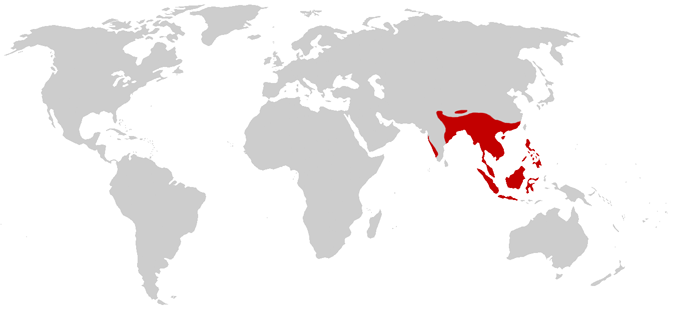
File:Distribution O. hannah.png


 Scientific classification

Kingdom: Animalia
Phylum: Chordata
Class: Reptilia
Order: Squamata
Suborder: Serpentes
Family: Elapidae
Genus: Ophiophagus
Species: O. hannah


It seems unfairly menacing that a snake that can literally "stand up" and look a full-grown person in the eye would also be among the most venomous on the planet, but that describes the famous king cobra.

King cobras can reach 18 feet (5.5 meters) in length, making them the longest of all venomous snakes. When confronted, they can raise up to one-third of their bodies straight off the ground and still move forward to attack. They will also flare out their iconic hoods and emit a bone-chilling hiss that sounds almost like a growling dog.

Their venom is not the most potent among venomous snakes, but the amount of neurotoxin they can deliver in a single bite—up to two-tenths of a fluid ounce (seven milliliters)—is enough to kill 20 people, or even an elephant. Fortunately, king cobras are shy and will avoid humans whenever possible, but they are fiercely aggressive when cornered.


King cobras live mainly in the rain forests and plains of India, southern China, and Southeast Asia, and their coloring can vary greatly from region to region. They are comfortable in the trees, on land, and in water.


King cobra's genus name, Ophiophagus, literally means "snake-eater", and its diet consists primarily of other snakes, including rat snakes, sizeable pythons and even other venomous snakes (including kraits, cobras and smaller members of its own species). When food is scarce, they may also feed on other small vertebrates, such as lizards, birds, and rodents. In some cases, the cobra may “constrict” its prey, such as birds and larger rodents, using its muscular body, though this is uncommon. After a large meal, the snake may live for many months without another one because of its slow metabolic rate. The king cobra's most common meal is the ratsnake; this leads them near human settlements.


They are the only snakes in the world that build nests for their eggs, which they guard ferociously until the hatchlings emerge.

King cobras may be best known as the species of choice for the snake charmers of South Asia. Although cobras can hear, they are actually deaf to ambient noises, sensing ground vibrations instead. The charmer's flute entices the cobra by its shape and movement, not by the music it emits.

Kamis, 03 Februari 2011

Taming Wild-Caught "Non-Venomous" Snake

Wild-caught snake usually tend to be more defensive because it is naturally and instinctively they will defend themselves from predators or other creatures that are considered a threat to them, including us, humans. But it is not impossible that we can tame a wild-caught snakes that if we want to maintain it. If we want to be a docile snake, snakes should be maintained is not the adult snake. Adult snake will be very difficult to tame because it has a very strong defensive instincts ingrained in his mind. It would be easier to tame the younger snake, because they will learn that we as his master will not hurt them, but actually treating them with great affection. 

Snake that had just caught from the wild is usually stressful and takes a while to adapt to the cage or the new environment. Periods of stress are usually marked by a snake would not eat. We recommend that the newly captured snakes do not immediately defused. Give them time to adapt to the cage / her new environment. Provide a comfortable cage, and enough water for drinking or bathing place, also provide hidding place if necessary. As much as possible not to hold the first-held unless necessary (for example, cage cleaning and drying). And try to give them food regularly (examples: 5-7 days once).

If the snake had to adapt to the cage and do not stress anymore (marked with a snake has been eating regularly), then we can begin the process of taming. No need to rush the process of domestication because the snake instead it can be stressful again. Do it gradually and regularly periodically, snake also will learn little by little that we are not going to hurt him, and eventually can become quiet and docile by itself gradually.

The following are some tips that can be tried in taming stage : 


1. At this first stage, do not be too long and often to handle your snake, because thats will be make your snake stress again. Handle only when cleaning cages. Soak your snake in a special place to soak with a filled water that is not too high / deep to remove dirt stuck to the skin. In the meantime you can clean the cage and replace it with a new base.

2. After a clean cage, try to handle your snake using a hook tool or it could be with gloves / mittens. Choose gloves that are not made of fabric / yarn wool because it can lead to tooth snake caught in fabric or knitted wool yarn such as wild-caught snakes bite you. Leather gloves or a tarp would be better to use.

3. Handle your snake with a steady and carefully. Snakes are still very defensive will not do anything and just wrapped around your hand firmly. Try to make your snake to move / walk from one of your hand to the others. In this stage try not to touch the head and neck of the snake because it can make them feel threatened, and then trigger a defensive nature. As much as possible avoid / minimize head of the snake from your face. Make a small moment, approximately 10-20min, and then enter back into his cage, and a few days then give the food to your snake as usual.

Repeat steps 1 through 3 for several times. If you still want to eat snake routine, continue to the next stage.

4. Add frequency handle your snake into 2 times a week. You can either handle it 4 days after the snake to eat and when cleaning the cage. Add also the time to be 20-30min. At this time you can try to touch the neck and swab the head. Do it slowly so the snake is startled and bit by bit they will learn that you will not be hurt. Repeat this step for several times.

5. If the snake has been seen more calm (usually marked with are rarely / never tried to bite again and snake movements, flexible and not stiff when walking on your hands), please try to handle your snake without using the tool again. Handle with extra caution, try not to make sudden movements which can make your snake surprised. Repeat this step for several times.

6. If after without using any tools, your snake is rarely / no longer try to attack, but usually will be seen is still jumpy when there is movement from its surroundings, you just need to add the frequency of handling to be 3-4 times a week. Do it all with patience and diligence stage, hopefully you snake will soon become a best friend who is very pleasant for you.

FYI: Each snake has a different character, although for the same type. This will affect how quickly taming process, depending on how the character of the snake.

Are you ready to be his friend???

Minggu, 30 Januari 2011

Reticulated Python (Python reticulatus)

Scientific Classification :
 
Kingdom : Animalia
Phylum : Chordata
Class : Reptilia
Order : Squamata
Family : Pythonidae
Genus : Python
Species : reticulatus


Location and Habitat
Reticulated pythons can be found throughout southeast Asia. Reticulated pythons inhabit all of the countries from India to Vietnam on mainland Asia. Reticulated pythons can also be found on islands and island chains in the seas of southeast Asia. Some of the islands that they are found on are Borneo, Sumatra, Java and the Philippines archipelago. Reticulated pythons inhabit the humid, moist, tropical rainforests of southeast Asia. They are usually found near sources of water such as ponds, streams and rivers. Reticulated pythons spend much of their time in the trees, but can also be found in the water.


Diet
Reticulated pythons feed mostly on smaller mammals. These small mammals include rats and monkeys. Reticulated pythons can also take larger mammals such as pigs or small deer. There are reports of attacks on humans but many of those reports are unsubstantiated.

Size and Description
Reticulated pythons are the longest snakes in the world, some measuring over 30 feet. Most grow to sizes of 15 - 25 feet. Reticulated pythons, however, are not the heaviest snakes. Their distant cousins, green anacondas of South America, are the heaviest of all snakes. 

The word "reticulated", according to Merriam-Webster, means to divide, mark, or construct so as to form a network. Reticulated pythons have a network of irregular patterns, spots, shapes and colors on their skin which forms excellent camoflauge. Up close, these colors may include tan, yellow, gold, brown and dark brown. Some of the shapes may resemble diamond-like structures with large spots that fill the interior. From even a short distance, reticulated pythons begin to take on a muddy appearance and it becomes difficult to distinguish the shapes or colors. Reticulated pythons' camoflauge makes them well suited to lying on a forest floor with dead leaf matter and mud, hiding in trees or on tree branches, or waiting in mud near a river bank. 

Reticulated pythons, like anacondas and boa contrictors, are not venomous, and do not kill their prey with bites alone. Rather, they will bite their prey and then wrap their massive bodies around the prey. As their prey is exhaling, reticulated pythons will squeeze their bodies tighter around their prey's lungs eventually causing suffocation. This process is called constriction. After this constriction process, reticulated pythons will begin to swallow their prey whole. Their jaws are held together by stretchy ligaments, allowing their mouths to open to sizes much larger than the initial size of their heads.

Adaptations
Reticulated pythons are cold-blooded, and live in warm, tropical climates in order to keep their blood warm year round.

Reproduction
Although there are many similarities between reticulated pythons and anacondas, one of the main differences is how they give birth. The eggs of anacondas hatch while still inside the mother, and the mother then gives birth to live young. 

Reticulated pythons, on the other hand, lay their eggs on the ground. Once the eggs are laid the mother will then lay on the eggs and incubate them until they hatch. Reticulated pythons can lay large numbers of eggs per clutch.

Sabtu, 29 Januari 2011

Boidae Family

Many snakes of five continents are members of the large family of reptiles called Boas. Most frequently however, when people use the term Boa they are referring to medium-large snakes of central and south America. In fact the name 'Boa Constrictor' is applied correctly only to the New World genus Boa. Boa constrictors are one of the most common and wide-ranging of reptile species. They are found from Northern Mexico near the U.S. border southward to Argentina. And exploit habitats as varied as lowland desert and semi-desert scrubland to tropical rainforest and coastal mountain cloud-forest. Boas have also colonized remnant continental and volcanic uplift islands as well as coral Cays or low islands in the Caribbean. Understanding the origins of the various boa groups as well as their morphological and behavioral differences is a very large part of the fun of keeping Boas.


Several subspecies of boas and many locality populations are recognized. Experienced observers of locality-type Boas report not only the unique colors and patterns displayed by the various groups but also more subtle differences as expressed in temperament, and other important behaviors such as feeding and food preference, reproductive cycles and courtship, preferred temperature cline and more. It is plain that the Boas as a group are closely related. It is also plainly true that Boas from different habitats have evolved unique sets of tools for survival and the overt physical differences only hint at how truly unique the different populations of Boas actually are. Observing and understanding these differences will assist you in efforts to keep and breed Boas. It is also our fervent hope that with an improved understanding of the fascinating differences among the Boas you will come to agree with us that preserving these groups in captivity and in nature are important goals. Always try to get captive- born stock and please think twice before you yield to the temptation to intergrade or crossbreed known locality Boas in your care.

Baby boas are among the most desirable of reptile pets and boas can be one of the easiest reptiles to keep. However, the size potential of adult boas should be considered before acquiring one. Size among boas is a factor of genetics and food availability. Some dwarfi-sh forms of boa grow to only about 1.5 meters in length but most all the boas will grow to be 2.2 meters or longer if well fed in captivity. Well cared-for boas regularly live for more than a dozen years, 20 year old boas are not uncommon. Boas can be bred in captivity with the proper attention to temperature gradients and feeding. The temperament of the boas ranges from quite docile to downright ornery. In reality Boas are neither tame nor mean, rather they simply display the inherited traits given them in nature in response to the novel situations they are subjected to in captivity. Genetics and (even more importantly) how well the keeper understands the animal's needs both play a role in how 'tame' your boa will be.

Remember that keeping Boas and other pets is a privilege. Be responsible and give your captives the very best in caging, food and care.


Interesting Facts of Boidae Snakes
  • All members of this family are non-venomous
  • These are relatively primitive snakes (older than North American species)
  • The females usually grow larger than the males
  • Most have vestigial limbs (or "spurs") and the remnants of a pelvic girdle
  • They kill their prey by constriction

The Crawl Cay, Belize Boa (Boa constrictor Imperator)

These are another of the insular island varieties of Boa constrictor inhabiting the barrier islands and coral atolls of the Caribbean Sea. Crawl Cay, Belize is one of the northernmost cays in the Turneffe Islands archipelago located east and slightly north of Belize city, a modest boat trip from Caulker Cay, home of yet another insular Boa. There are other islands referred to as Crawl Cay, notably in the Bay of Chiriqui among the archipelago of Bocas del Toro on the northeastern coast of Panama. It is possible boas from Panama or other islands locally called Crawl cay or Key have made their way into herpetoculture, here or elsewhere. This could explain the unusual diversity between some captive colonies of these rare snakes, in the United States and abroad.

Crawl Cay, Belize boas are considered among the smaller Boa localities, usually less than 1.8 meters in length and adults are somewhat stocky, solid-feeling snakes. Neonate Crawl Cay boas are not eye-catching, patterning is indistinct and unremarkable. Tail blotches may be a dull yellow or orange. Mature adult Crawls are more interesting, they have a lower-than-average saddle count (21-23 S-V) for central American constrictor and the pattern is faded and reduced, both dorsally and laterally, revealing a silvery-grey or coppery-pink boa with large scattered jet speckles, prominent eyes and a heavily black-pigmented tail with just a hint of yellow, orange or silver showing through. The way in which the black pigment is distributed inside of and between the scales on Crawl Cay boas may be somewhat unique and identifiable.


Unlike the Caulker Cay boas, of which only a handful were brought to the United Sates, according to knowledgeable sources many Crawl Cay boas were imported, mostly in the 1970's. These boas were brought by tourists, fishermen, divers and university groups, many of who presented the snakes to reptile dealers, perhaps as a way of offsetting their expenses. One such group of snakes was captured and imported to the U.S. by a Texan, Bob Sears, who kept and bred them. Where all the imported Crawl Cay boas eventually went and whether or not they were bred and bred true to the locality is not known. Thankfully, a group of Bob's boas ended up with Tim Meade, who did also breed them in the 1990's. This lineage is all that is left of the (verifiable) boas of Crawl Cay, Belize in culture.

Adult Crawl Cay boas are very good cage and display snakes, typically laying still in classic ambush posture, their unusual colors and markings are surprisingly effective camouflage, but their temperament is not the best. They are easily scared and will frequently stiffen and strike if startled or handled roughly. Baby Crawl cay boas have been known to be reluctant feeders on standard neonate boa fare.

Whether or not these island boas yet survive in numbers on Crawl Cay (Belize) is not known. In any event the entire Turneffe Islands archipelago is now a national reserve of Belize and it is very unlikely any additional Boa of that locale will be brought to herpetoculture. Serious herpetoculturists everywhere should agree to work to safeguard the Crawl Cay line, in nature and in culture.

Rabu, 26 Januari 2011

Green Anaconda (Eunectes murinus)

Scientific classification :

Kingdom : Animalia
Phylum : Chordata
Class : Reptilia
Order : Squamata
Suborder : Serpentes
Family : Boidae
Subfamily : Boinae
Genus : Eunectes
Species : E. murinus


The world's largest snake is the green anaconda (Eunectes murinus). This massive snake can be found throughout the northern part of South America. An adult green anaconda can reach lengths of 25 feet (7.6 meters) and can weigh more than 200 pounds (91 kg). Unless you study reptiles, most of what you know about the green anaconda probably comes from popular culture (movies, stories, legends, etc.). So there's a good chance you've encountered quite a few myths and misconceptions over the years. In this article, I'll try to set the record straight about the world's largest snake, the green anaconda. First thing's first. Just how big does this snake get? That depends on whom you ask. For example, I saw a National Geographic article that claimed the green anaconda can weigh up to 500 pounds (227 kilograms). But no snakes this large have ever been documented, much less donated to a zoo or museum. So we have to take such claims with a grain of salt.

Over the years, there have been several captive specimens (in zoos) longer than 25 feet, or 7.6 meters. But there has never been a documented case of a green anaconda growing beyond 30 feet. For many years, the Wildlife Conservation Society has offered a large cash reward for anyone who can document a specimen longer than 30 feet. Nobody has claimed this prize. But it's not the length that makes it the world's largest snake. It's a combination of length and girth. The reticulated python can grow slightly longer than the anaconda. But in terms of sheer mass and bodyweight, no other snake comes close to the green anaconda. It can weigh well over 200 pounds, with a diameter of more than 15 inches. It is a massive snake when fully grown.

When they are fully grown, these snakes do not have any natural predators. This means they are apex predators. They sit (or slither) at the top of their food chain. 

When most people talk about "the anaconda," they are usually referring to the green anaconda, the world's largest snake. But there are actually two anaconda species in South America. The lesser-known yellow anaconda (Eunectes notaeus) does not get nearly as large as its green cousin. On average, a full-grown yellow anaconda will be 10 - 12 feet long.Another interesting fact about the green anaconda is that it spends much of its life in or near water. There are several reasons for this. First, there is the size factor. If you were as large as the world's largest snake, you would probably spend a lot of time in water too. Swimming in water is much easier than crawling on land, as far as gravity is concerned. The anaconda also preys on animals that can be found in or near the water. It will readily eat fish, caiman and other animals that dwell in the water. And it will also ambush animals that come in for a drink, such as deer and tapir. They reach their monumental size on a diet of wild pigs, deer, birds, turtles, capybara, caimans, and even jaguars. Anacondas are nonvenomous constrictors, coiling their muscular bodies around captured prey and squeezing until the animal asphyxiates. Jaws attached by stretchy ligaments allow them to swallow their prey whole, no matter the size, and they can go weeks or months without food after a big meal.


During the mating season, several males will often compete for the same female. They will tangle up into a "breeding ball," sometimes staying like that for weeks. A female may give birth to 50 or more baby snakes.

Anacondas have been portrayed in horror literature and film, often with the ability to swallow adult humans; these traits are occasionally also attributed to other species, such as the Burmese python and the boa constrictor. Among the most popular films that feature it are the 1997 film, Anaconda, along with its three sequels Anacondas: The Hunt for the Blood Orchid, Anaconda 3: Offspring and Anacondas: Trail of Blood. This species is also the main antagonist in Mathias Bradley's novel, Anacondas: The Terror of the Amazon Rainforest, in which multiple hybrid anacondas escape from a research facility in the Amazon Rainforest and come into contact with a toxic chemical that causes them to rapidly mutate into gigantic snakes. A more positive depiction of the anaconda exists in the short stories "Anaconda" and "El Regreso de Anaconda" ("The Return of Anaconda") by Horacio Quiroga, which are told from the anaconda's point of view.

Jumat, 21 Januari 2011

Corn Snake (Elaphe guttata)


Scientific classification : 
Kingdom : Animalia
Phylum : Chordata
Class : Reptilia
Order : Squamata
Suborder : Serpentes
Family : Colubridae
Genus : Elaphe
Species : E. guttata


Corn snakes (Elaphe guttata) are one of the most available snakes in the pet trade today. Vast numbers of corn snakes are captive bred annually, and are justifiably one of the most popular snakes of all time. Corn snakes are relatively small, rarely exceeding five feet in length, active feeders, tolerate a wide variety of environmental conditions, come in a dazzling arry of color morphs, and are very easy to breed. All of these factors combined make the corn snake an excellent choice for both the beginning and advanced reptile hobbyist.

Enclosure Size :
Corn snakes are relatively small, and as such, they do not require large enclosures. A baby corn snake can happily live in a ten gallon aquarium or enclosure of similar size. Some people choose to keep baby corn snakes in plastic shoeboxes with holes punched in the side. This type of enclosure is acceptable as long as appropriate heating is provided. Upon reaching full adult size (about three to four years), a corn snake will require an enclosure with the minimum dimensions of a standard twenty gallon long aquarium. Larger aquariums such as a thirty gallon breeder or fifty-five gallon tank are also appropriate. No matter whether your corn snake lives in a humble home or a palace, there are several important details to keep in mind when setting up your new pet.

Substrate :
The substrate of a cage is the material that is on the bottom. There are appropriate and not so appropriate choices of substrate in corn snake housing. Cedar shavings are unacceptable as they cause respiratory problems in snakes.  I personally do not recommend pine for the same reason, but others have used this substrate without any problems.  Corn cob bedding (manufactured for use with birds) should not be used as a substrate because it causes excessive drying of dermal tissues and can cause serious intestinal blockage if swallowed. Acceptable substrates include reptile bark, butcher paper, paper towels and Astroturf.

Reptile bark can be purchased in pet stores, and is attractive and natural-looking. Butcher paper can be acquired in many places such as home depot or art supply stores. This substrate, while not particularly attractive, allows one to keep the cage very clean by continuously replacing the soiled paper. Paper towels have the same advantages and disadvantages of butcher paper. Astroturf can be used, but it does tend to rot easily if wetted, so it is best to have several pieces cut to fit the cage so you can rotate dirty and clean pieces.

Appropriate Heating :


There are several choices for appropriate corn snake heating. Whatever choice of heating is used, it is very important to provide one area of the cage where the ambient (air) temperature is 80-85 degrees F. Corn snakes, like all reptiles, do not make their own body heat and rely on a behavioral mechanism called thermoregualtion to regulate their body temperature. Thermoregulation means that when a reptile is too cool, it moves to an area to warm itself, and when it is too hot, it moves to a cooler area. Access to warm areas are critically important to the health of your snake. Appropriate heating is required for proper digestion and the effective functioning of the immune system.

If the tank has a screen top, a shop light or metal reflector may be placed on top of the cage, to one side, with a heating bulb inside to create a basking area of 80-85 degrees F. Another method of heating is the use of quality undertank heating pads. Undertank heaters are plastic with one adhesive side. The adhesive side of the heater is used to attach it to the bottom of the outside of the tank, on one side of the cage. These heaters can only be used with certain types of cages, so check the directions before purchase. Hot rocks are not recommended for corn snake heating for several reasons.


Hot rocks provide a localized heat source that is often too hot. As a result, the snake will curl itself about the rock in an attempt to raise its body temperature, this can result in serious thermal burns. Think about this from the snake's point of view. One tiny area of the cage is 100 degrees F, and the rest of the cage is freezing. Without some type of heat, reptiles will get sick, so the animal will use whatever source of heat is provided, even if it is too hot. Some of the new hot rocks that have thermostats are a much better choice if a hot rock must be used. If not, at least burying the hot rock in some substrate will help to diffuse the heat. It is much better to provide indirect heating, or heating that the animal has no direct access to. This will prevent thermal burns from occurring.

Feeding :
Corn snakes are rarely picky eaters if they have the proper heat and enclosure. One important aspect of feeding that is often overlooked is the addition of hiding areas to the cage. Corn snakes, like most snakes, like to feel secure in their environment. One way of providing for this need to is put hiding spots in the enclosure. Hiding spots can be made of anything, as long as the snake can completely fit inside the area and hide itself from view. Old cardboard boxes are good for this, but so are many of the commercially manufactured hiding spots available in pet stores. A hiding spot should be placed both on the warm end and the cool end of the cage, so that the animal can feel secure in any spot. Corn snakes kept without appropriate hiding areas become stressed and may refuse to eat.

Hatchling corn snakes begin eating pinky mice, and progress up to adult mice once they are mature. A good rule of thumb is to feed the snake a food item that is the same, or close to, the snake's diameter. Feed an item that is too large, and the snake will often regurgitate it. Snakes will also regurgitate if they do not have a warm area or if they are handled too soon after they eat. Corn snakes can be fed two times a week, but once is usually enough. Clean water should be available at all times, corn snakes drink often.

Conclusion :
Corn snakes are justifiably one of the most popular pet snakes of all time. Corn snakes come in many beautiful colors, and are hardy and docile. This care sheet is not all of the information required to care for a corn snake properly, but it is a start. If you own a corn snake or plan on purchasing one, it is YOUR responsibility to thoroughly research the needs of your pet, doing so will make both your lives easier.

Boa Constrictor (Boa constrictor)

Scientific classification : 
Kingdom : Animalia
Phylum : Chordata
Subphylum : Vertebrata
Class : Reptilia
Order : Squamata
Suborder : Serpentes
Family : Boidae
Subfamily : Boinae
Genus : Boa
Species : B. constrictor


Boa constrictors wear some of the most distinctive markings of all reptiles. Depending on the habitat they are trying to blend into, their bodies can be tan, green, red, or yellow, and display cryptic patterns of jagged lines, ovals, diamonds, and circles.


Boas are nonpoisonous constrictors found in tropical Central and South America. Like their anaconda cousins, they are excellent swimmers, but prefer to stay on dry land, living primarily in hollow logs and abandoned mammal burrows.

Significantly smaller than anacondas, boas can grow up to 13 feet (4 meters) long and weigh more than 100 pounds (45 kilograms). Their jaws are lined with small, hooked teeth for grabbing and holding prey while they wrap their muscular bodies around their victim, squeezing until it suffocates. Boas will eat almost anything they can catch, including birds, monkeys, and wild pigs. Their jaws can stretch wide to swallow large prey whole.

Female boas incubate eggs inside their bodies and give birth up to 60 live babies. Boas are about 2 feet (0.6 meters) long when they are born and grow continually throughout their 25 to 30-year lifespan. The largest boa constrictor ever found measured 18 feet (5.5 meters).

Hunted for their fine, ornate skin and for sale in the exotic pet trade, some boa constrictors are endangered and most have protected status in their range.

Kamis, 20 Januari 2011

Black Mamba (Dendroaspis polylepis)


Scientific Classification
Kingdom : Animalia
Phylum : Chordata
Class : Reptilia
Order : Squamata

Suborder : Serpentes
Family : Elipidae
Genus : Dendroaspis
Species : D. Polylepis


The Black Mamba is the most deadly snake in the world. They grow 14 feet in length, that's make they become the longest venomous snake in Africa, and can travel at speeds 16 - 20 mph, and it's make they become the fastest  snake in the world. They have a head shaped like a coffin. The Black Mamba is not actually black. They have a brownish-gray body with a light belly and brownish scales along its back. It gets its name from the color of the lining of its mouth, which is purple-black, and which it displays when threatened.

File:Black Mamba Range.svgThe Black Mamba lives in South Africa. They like open, low habitats such as savannas, rocky places and open woodlands. They are active during the day. They often sleep in hollow trees, burrows, rock crevices, or empty termite mounds, and will come back to the same place every night.

The Black Mambas feed on small mammals and birds, like voles, rats, squirrels, mice, rats, or bush babies. Once a Mamba was found with a parrot in its stomach, another with a full grown Forest Cobra! It will strike a large animal and then release it. It then stalks their victim until it becomes paralyzed. With smaller animals it will strike and hold on until the animal becomes paralyzed. Its flexible jaws and scales makes it possible to eat the animal whole.


Several weeks after a pair of mamba mate, the female will find a good place to lay 6-17 eggs. The burrow must be damp but not wet, and warm, but not too hot. After she lays her eggs the female leaves. The young snakes are about 16-24 inches long when they hatch three months later. They reach maturity when they are 3-4 feet in length.

The Black Mambas are found in pairs or small groups. They are very nervous, and head away fast when a human approaches. When the mamba feels threatened it will raise its front and head about 3-4 feet off the ground, open its mouth, spread a flat hood, and shake its head. When they attack they will make several quick strikes, and escape as fast as they can. They can strike from 4-6 feet away. Before antivenins were developed, a black mamba bite was 100% fatal.

They are invulnerable, because no animal can actually kill them. Their venom can kill just about anything, so they don't have much to worry about. The mamba is mainly threatened by habitat destruction. Mongooses are the main predators of the black mamba. They usually prey on young snakes and eggs. Mongooses are notable due to their resistance to snake toxins. This resistance is caused by mutations in their nicotinic acetylcholine receptor. These mutations prevent the neurotoxin present in snake venom from binding to the receptor, thus preventing the associated toxicity. Because of the mongoose's resistance to snake venom, adult mambas have trouble fighting them off, although mongooses seldom attack adult snakes as they are too large for the mammals to kill with ease. Cape file snakes are also predators of young black mambas.

 
Powered by Blogger | Printable Coupons