Tampilkan postingan dengan label Venomous Snake. Tampilkan semua postingan

Rabu, 02 Maret 2011

King Cobra (Ophiophagus hannah)


                         Facts

Type                                 : Reptile
Diet                                  : Carnivore
Average life span in the wild: 20 years
Size                                  : 13 ft (4 m)
Weight                              : Up to 20 lbs (9 kg)
Group name                       : Quiver
Did you know?
Synthetic cobra venom is used in pain relievers and arthritis medication.
Size relative to a 6-ft (2-m) man:
Illustration: King cobra compared with adult man

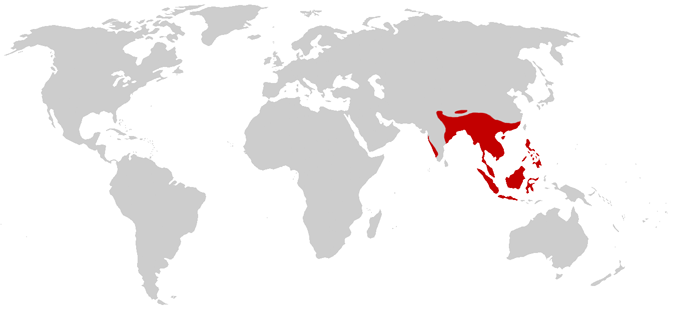
Regional Distribution


File:Distribution O. hannah.png


 Scientific classification

Kingdom: Animalia
Phylum: Chordata
Class: Reptilia
Order: Squamata
Suborder: Serpentes
Family: Elapidae
Genus: Ophiophagus
Species: O. hannah


It seems unfairly menacing that a snake that can literally "stand up" and look a full-grown person in the eye would also be among the most venomous on the planet, but that describes the famous king cobra.

King cobras can reach 18 feet (5.5 meters) in length, making them the longest of all venomous snakes. When confronted, they can raise up to one-third of their bodies straight off the ground and still move forward to attack. They will also flare out their iconic hoods and emit a bone-chilling hiss that sounds almost like a growling dog.

Their venom is not the most potent among venomous snakes, but the amount of neurotoxin they can deliver in a single bite—up to two-tenths of a fluid ounce (seven milliliters)—is enough to kill 20 people, or even an elephant. Fortunately, king cobras are shy and will avoid humans whenever possible, but they are fiercely aggressive when cornered.


King cobras live mainly in the rain forests and plains of India, southern China, and Southeast Asia, and their coloring can vary greatly from region to region. They are comfortable in the trees, on land, and in water.


King cobra's genus name, Ophiophagus, literally means "snake-eater", and its diet consists primarily of other snakes, including rat snakes, sizeable pythons and even other venomous snakes (including kraits, cobras and smaller members of its own species). When food is scarce, they may also feed on other small vertebrates, such as lizards, birds, and rodents. In some cases, the cobra may “constrict” its prey, such as birds and larger rodents, using its muscular body, though this is uncommon. After a large meal, the snake may live for many months without another one because of its slow metabolic rate. The king cobra's most common meal is the ratsnake; this leads them near human settlements.


They are the only snakes in the world that build nests for their eggs, which they guard ferociously until the hatchlings emerge.

King cobras may be best known as the species of choice for the snake charmers of South Asia. Although cobras can hear, they are actually deaf to ambient noises, sensing ground vibrations instead. The charmer's flute entices the cobra by its shape and movement, not by the music it emits.

Kamis, 20 Januari 2011

Black Mamba (Dendroaspis polylepis)


Scientific Classification
Kingdom : Animalia
Phylum : Chordata
Class : Reptilia
Order : Squamata

Suborder : Serpentes
Family : Elipidae
Genus : Dendroaspis
Species : D. Polylepis


The Black Mamba is the most deadly snake in the world. They grow 14 feet in length, that's make they become the longest venomous snake in Africa, and can travel at speeds 16 - 20 mph, and it's make they become the fastest  snake in the world. They have a head shaped like a coffin. The Black Mamba is not actually black. They have a brownish-gray body with a light belly and brownish scales along its back. It gets its name from the color of the lining of its mouth, which is purple-black, and which it displays when threatened.

File:Black Mamba Range.svgThe Black Mamba lives in South Africa. They like open, low habitats such as savannas, rocky places and open woodlands. They are active during the day. They often sleep in hollow trees, burrows, rock crevices, or empty termite mounds, and will come back to the same place every night.

The Black Mambas feed on small mammals and birds, like voles, rats, squirrels, mice, rats, or bush babies. Once a Mamba was found with a parrot in its stomach, another with a full grown Forest Cobra! It will strike a large animal and then release it. It then stalks their victim until it becomes paralyzed. With smaller animals it will strike and hold on until the animal becomes paralyzed. Its flexible jaws and scales makes it possible to eat the animal whole.


Several weeks after a pair of mamba mate, the female will find a good place to lay 6-17 eggs. The burrow must be damp but not wet, and warm, but not too hot. After she lays her eggs the female leaves. The young snakes are about 16-24 inches long when they hatch three months later. They reach maturity when they are 3-4 feet in length.

The Black Mambas are found in pairs or small groups. They are very nervous, and head away fast when a human approaches. When the mamba feels threatened it will raise its front and head about 3-4 feet off the ground, open its mouth, spread a flat hood, and shake its head. When they attack they will make several quick strikes, and escape as fast as they can. They can strike from 4-6 feet away. Before antivenins were developed, a black mamba bite was 100% fatal.

They are invulnerable, because no animal can actually kill them. Their venom can kill just about anything, so they don't have much to worry about. The mamba is mainly threatened by habitat destruction. Mongooses are the main predators of the black mamba. They usually prey on young snakes and eggs. Mongooses are notable due to their resistance to snake toxins. This resistance is caused by mutations in their nicotinic acetylcholine receptor. These mutations prevent the neurotoxin present in snake venom from binding to the receptor, thus preventing the associated toxicity. Because of the mongoose's resistance to snake venom, adult mambas have trouble fighting them off, although mongooses seldom attack adult snakes as they are too large for the mammals to kill with ease. Cape file snakes are also predators of young black mambas.

 
Powered by Blogger | Printable Coupons